
Take on the NES Library

An 8-bit Extravaganza!

sports

MAY
22
2026
0

#182 – Bases Loaded 4

We regret to inform you that the bases are now overloaded.

It’s a perfect day to play two!

To Beat: Win the World Series
Played: 8/4/21 – 12/12/21
Difficulty: 4/10
My Difficulty: 4/10
My Video: Bases Loaded 4 Part 1 | Part 2 | Part 3

When I first started this project, I was already well aware of the Bases Loaded series. I knew the games had long seasons to complete, and I knew that the 3rd installment had the unique Perfect Game requirement. I have no problem playing and enjoying baseball games, but I was not thrilled about the prospect of full season play for three of these games. I had once buried these games at the end of my list and then reversed those plans to put them into the mix sooner. At the start of this project, I would have never guessed I would finish all four Bases Loaded games before finishing 200 total games, but here we are! In this review we will go over Bases Loaded 4 as well as do the definitive ranking of the entire series. Let’s get started!

This review will focus primarily on the differences Bases Loaded 4 has to offer in the series. You can read my previous reviews on Bases Loaded, Bases Loaded II: Second Season, and Bases Loaded 3 for more information about the series. Bases Loaded 4, like the others in the series, was developed by Tose and published by Jaleco. The Japanese name is Moe Pro! Saikyo Hen which roughly translates to Burn! Stronger Version. The game launched in Japan in November 1991 and arrived in North America on the NES 18 months later in April 1993.

From a gameplay perspective, Bases Loaded 4 is very close structurally to Bases Loaded 3, but there are a few differences beginning with game setup. First and foremost, Bases Loaded 4 eschews the perfect game objective of Bases Loaded 3 and goes back to the full season mode as the primary way to play. From the title screen, either start up a new season or continue a previous season with a password. You can also choose to play an exhibition game in single player, two player, or watch mode. The top level of the title screen menu also has a small options menu. Here you can turn the music on or keep it off with sound effects playing only, and you can toggle if you want to play with a designated hitter or not. Past the title screen, Bases Loaded 4 goes straight to team selection. There is no choice of stadium like in Bases Loaded 3. There is also no Edit team in this game. Choose one of the 12 built-in teams only. There is an Eastern division and Western division of six teams each like the previous game, and the teams are a bit different than before. The rosters are also completely different this go-around, just like we’ve seen throughout this series. Finally, before every game you can manually set the lineup using the exact same screen found in Bases Loaded 3. With all the setup complete, it’s time to play ball!

Check out these logos!

The method of pitching was updated again in Bases Loaded 4, but it controls similarly to the previous game. Choose a D-pad direction, or none at all, to choose a pitch type, then press A to start the windup. There’s a chart in the manual for which pitch type is thrown when a direction is targeted. For example, a slider is always thrown up and away from the batter, a change up is always a middle-inside pitch, the fastball is always aimed high, and so on. You can tap A again multiple times during the windup to gradually increase the direction of the pitch. During the windup, instead of using the D-pad to adjust speed, you use the D-pad to adjust the break of the pitch. Between the pitch types and the on-the-fly adjustments to the curvature, it seems like you can throw just about anything you want anywhere you want, though honestly I can’t say if that really took effect that way because I didn’t experiment too much with the pitching. More on that later!

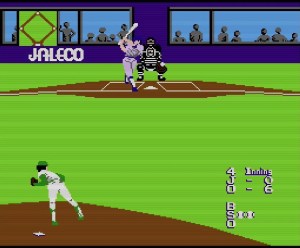
The defense in Bases Loaded 4 is identical to Bases Loaded 3 with the perspective from center field looking in. The only difference here is that there is a more detailed mini-map that aids with making defensive plays in the outfield. Instead of occupying a corner of the screen, it takes up almost the full right side of the screen overlaid on top of the action. You can see all bases, base runners, fielders, and the ball, all in one view. I feel it does not distract any from the gameplay itself or that it prevented me from making a play in any way. It for sure helped in positioning my outfielders better when they were offscreen. The remaining controls for throwing, running, and targeting a base are the same as the previous game and many other NES baseball games.

Batting is almost the same as before as well, with only a few small tweaks. The simplified batting is the same here, either swing level with A, swing high with Up and A, and low with Down and A. This time you have a little bit more control of positioning your batter in the box prior to the pitch. Bunting is done with the B button this time instead of Select. The A button will cancel a bunt attempt and let you swing away.

Baserunning is identical in Bases Loaded 3 and 4. To recap, press the direction of the base you want, then press B to move the runner ahead to the next base or A to move the leading runner back to the previous base. You can also press and hold both A and B together to halt all runners on the basepaths, in case you want to wait for a fielder to catch a fly ball or something like that.

I’ve seen this view a lot.

The most notable change to this installment is the star system. Every player may have stars displayed next to their name that are earned for different events during play. White stars are awarded for good plays while black stars are given out for various miscues. Think of the white stars as positive points and black stars as negative points. Getting a black star will remove an existing white star before giving any black stars, and vice versa. A player can have up to 8 stars at one time, and they only count for the current game. The stars themselves influence how well a player is doing and will affect their abilities during a game, good or bad. On batting, you can earn a white star by making an excellent play, such as hitting a homerun, or you get a black star for striking out. On the pitching side, white stars are for strikeouts and black stars are for allowing a run. During fielding, white stars are for great plays and black stars are given when you miss a ball or make a bad throw. Catchers get a white star for throwing out base stealers and a black star for making an error. Pitchers also lose a white star every inning due to fatigue, and two stars every inning after five. Pitchers aren’t given black stars for fatigue, they just lose white ones.

The perfect game winning condition from Bases Loaded 3 is gone and is replaced by winning a complete season like the first two games. This time you need to win 70 games out of 130 to advance to the Super Series, which is a best-of-7 series against the best team from the alternate division. Win 4 games against them to win the Super Series and beat the game. So you need to win 74 baseball games here, down from 80 and 79 games in Bases Loaded and Bases Loaded II respectively.

This was my first time playing Bases Loaded 4, on par with the rest of the series. This is far and away the hardest game of the four to acquire from a collecting standpoint. This is one of the few sports games that holds a relatively high value, as it was released in limited amounts in 1993, a couple of years after the Super Nintendo captured the collective gamers’ attention instead. This was one of the last 40 or so games I got for my collection. The list of games I had left were almost all expensive but this one was affordable back in 2015. I recall paying about $20 for my loose cart. Bases Loaded 4 currently sells for around $60-70.

I hit so many lazy fly balls like this one.

I am never thrilled about buckling down for a long season mode in an NES sports game, but considering how well Bases Loaded 3 went not long before this one, it felt manageable to do so this time. Pace of play is the most important factor for my enjoyment in this game. I clocked individual games at around 20 minutes each on average, roughly on par with the prior two games. That seems to be the sweet spot for game time. Completing the full season took me 32 hours which was longer than I would have expected. The total playtime was impacted by two rules. First is that the mercy rule from Bases Loaded II makes its return. Any time a team leads by 9 or more runs after the bottom of an inning, the game ends early. The other rule is new to the series, kind of. In previous games, being tied up after 12 innings counted as a win anyway. In Bases Loaded 4, not only do games last up to 18 innings, but if you are still tied after that, the game is counted as a tie. This is effectively the same as a loss, only worse since it took two full games worth of innings for a non-winning effort.

Choosing my team for the season was straightforward enough. I will always pick a Chicago based team if available, so that was my team for the season. There is nothing that really stands out with this team. They have a few good offensive players. By the numbers, the 4, 5, and 8 hitters were the best ones. This seemed like a good enough hitting team to work with. On pitching, the rotation of Fox, Lawson, Morris, and Gantos were relatively good and carried me throughout the season. There were no eye-popping numbers with any of these players, but nothing outlandishly bad either.

In the first Bases Loaded, I was able to find a pitching exploit the trivialized the entire game. I got through Bases Loaded II in part by finding inefficiencies in the game’s fielding and baserunning. I finished Bases Loaded 3 so quickly that I didn’t have time to find any of that stuff. My approach in Bases Loaded 4 harkened back to the original game through pitching, not perfect pitching, but effective pitching. The general strategy I came up with was pitching outside on the edge of the strike zone. I pressed A to initiate the pitch, the D-pad to throw away, and then around 6 taps of the A button. Most of the time that got a swing and a miss while allowing the batter to inch closer to the plate. The next pitch needed 7 taps of A, then 8 on the following pitch. That resulted in a lot of 3 pitch strikeouts to right-handed batters. Left-handed batters were treated similarly, with 4 or 5 taps of the A button instead of 6 or more. Should the batter not swing, I would have to throw one inside to back them off the plate, then go back to the top of the routine for more strikes. This method was not foolproof. I would sometimes walk batters, hit batters on the inside pitches, or generate some mostly weak contact. Overall, I was able to get enough strikeouts to get my pitcher to the full 8 stars and keep them there the entire game, only allowing runs on rare occasions.

Maxing out pitcher star power worked very well!

In spite of my successful pitching strategy, I had no such luck with batting. This was the hardest game in the series for me to generate consistent offense. I would put a large portion of the blame on the star system. Strikeouts are most often the worse batting outcome anyway, but earning a black star on top of that meant the batter was almost certainly useless for the entire game. Most balls put into play are weak contact and easy outs with the dreaded black star. Generating any kind of solid contact was an issue for this entire game. Any sort of loft on the ball was enough to get an opposing fielder underneath it, and even line drives seemed to find gloves quite often. The opposing defense was pretty ruthless in the game, and combined with my propensity for striking out, it made this game doubly difficult.

As with the other season-based games, I kept tabs on my season record as well as notable events that happened throughout, and this should state my case well on how I dialed in the pitching and subsequently failed on offense. The learning phase of the season resulted in a 5-6 record to start. In those 11 games I was outscored 33 runs to 18. Somehow in Game #3, I scored 7 runs in a 7-6 victory, which leaves only 11 runs scored across the other 10 games. After that stretch, I sailed the rest of the way. I allowed only 6 total runs over the rest of the season. In Game #29, I lost 2-0, my only other loss during the season. The very next game, I had my first tie in a scoreless game. I ended up tying 5 games overall, finishing with a final record of 74-7-5.

Here are some other notable achievements. I pitched a Perfect Game in Game #18, a 1-0 victory. Including the perfect game, I had 28 1-0 wins. I won 8 games in extra innings, including two games back-to-back where I didn’t take a lead until the 18th and final inning. Two games were won via the mercy rule, a 10-0 6th inning win in Game #44 and a 9-0 victory in the same inning of Game #80. The only other high scoring games were a pair of 7-run games, a pair of 6-run games, and about a half-dozen 5-run games. Finally, I lost by a walkoff home run in Game #6 and won via a walkoff home run in Game #27. The winning formula for me was excellent pitching and just good enough offense.

Putting up runs is so big.

Now that this long series of NES games are behind me, I can confidently rank this entire series. This was an easy decision to make. In order from least to most favorite, it’s 1, 4, 2, and 3. The first game was easy, the easiest of all of them, but the slow pacing of in-game actions made me want to yank my hair out and makes it the least desirable game to ever consider going back to play. Bases Loaded 4 is next up. It has many improvements in the gameplay and is paced much faster, but the bump in challenge and the potential for long 18 inning ties lock this game in 3rd place. Bases Loaded II was my favorite one to play as my strategy was more focused on defense and baserunning exploits than just hitting or pitching. It was also the quickest full season entry, and the biorhythm system made some players really fun to watch when their stats aligned at the top of the meter. But no matter what, the Perfect Game requirement for Bases Loaded 3 makes it my favorite one of all. It’s a neat way to experience beating an NES sports game, and of course the short overall length was most welcome!

The best way I can describe Bases Loaded 4 is that it combines the full season play of the first two games with the gameplay style and framework of the 3rd entry. The gameplay is solid all the way through. The graphics, music, and controls are all what you would expect out of a late era NES game by an experienced development team. I’m glad the developers improved on the fielding, which was my main complaint about Bases Loaded 3. The star system, while troubling to me personally, is a strong enough mechanic to be a fine addition to the series. Unfortunately, while the game is well made, it isn’t likely to get much attention because it is an uncommon, expensive NES sports game. That’s why I do what I do, to give some attention back to some unloved and underappreciated games, even the full season sports games like this one.

#182 – Bases Loaded 4

by :
comment : 0
 
NOV
23
2018
0

#102 – Snoopy’s Silly Sports Spectacular

I like good alliteration, and I like this game too.

Where’s the rest of the title?

To Beat: Score 10,000 points in the Total Game Mode
To Complete: Score 15,000 points in the Total Game Mode
What I Did: Scored 16,460 points
Played: 10/9/18
Difficulty: 2/10
My Difficulty: 2/10
My Video: Snoopy’s Silly Sports Spectacular Longplay

Today we have a sports game that doesn’t feel like one. I remember one time when I was browsing through game lots on eBay. I was looking into one where the seller highlighted that there were all good games in the lot and no sports titles. Just about the first game I saw in there was this Snoopy game. I just rolled my eyes and said, “oh come on, the word sports is right there in the title!” Sports games have this negative stigma with them, particularly in collector mindsets for older systems. Games like this will blur the lines and somehow avoid all that negativity. I can see why Snoopy’s Silly Sports Spectacular would fit that mold with its cartoon events that don’t always make sense but are pretty fun to play.

Snoopy’s Silly Sports Spectacular was released on the NES in April 1990 in North America only. Kemco both developed and published the game. This is another game with an interesting background. It is a loose port of the game Alternative World Games created by Gremlin Graphics in 1987 for Commodore 64, ZX Spectrum, and Amstrad CPC. Kemco adapted the game for the Famicom in September 1988. In Japan, they had the licensing rights for Disney, so they made Donald Duck the main character and named the game Donald Duck. Capcom held the rights for making Disney games in the US, so when Kemco brought the game over, they licensed the Peanuts characters and changed the game into Snoopy’s Silly Sports Spectacular.

Try to keep up, Spike.

The game is an Olympic-style contest. These are Snoopy’s International Games consisting of six different events: Sack Race, Boot Throwing, Pogo, Overboard, Pile of Pizza, and River Jump. You can play the game with either one or two players. Should you choose two-player mode, two events are simultaneous play and the rest are alternating play. The games are set in Italy and Greece so you have nice architectural backdrops to go along with the silly games. You can play events individually for fun or practice, but the main mode is the Total Game mode where you play all six events in a row. In this mode, you want to break the world record of 10,000 points to win 1st place and beat the game.

The Sack Race takes place on a city street. You control Snoopy and either the second player or computer controls his brother, Spike. You begin waiting behind the starting line waiting for a balloon to pop to signal the start of the race. Press and release the A button to jump forward. Just tapping A will only perform a tiny hop. You’ll have to learn the rhythm to go as fast as possible. Use the D-pad to adjust your position on the street. There are manholes littered around the course that open at random, and if you get caught up in one you will trip and fall behind. You can’t interfere with your opponent at all, so you only need to worry about the manholes. If one player falls too far behind, Woodstock will push that player up to close the gap so that both characters remain on screen. You have 50 seconds to reach the end of the course. In the Total Game mode, you earn 40 points for every second remaining on the timer, minus some points if you need a Woodstock push.

Weeeee!

In the Boot Throwing competition, you want to throw your boot as far as possible. Begin by pressing Down, then rotate your thumb around the D-pad in a counter-clockwise motion. It turns out you only need to alternate between pressing Down and Right, but doing the rotation helps greatly. This will wind up your throw, and then you press A to let it loose. With good timing you will throw it far ahead, but you can also throw it straight up, straight into the ground, or even backwards for no distance. On a forward throw, Woodstock will go out and tell you how far you threw. You get two separate throws. The best throw I could do was 30 feet which was worth 500 points. The scoring is prorated for shorter distances, and both throws are scored separately and added together for the event.

The Pogo event is a simple obstacle course. Press Right to move Snoopy forward and press and hold A to bounce high. Snoopy will do small bounces automatically. He also cannot move backward. There are four tall walls of equal height that Snoopy must jump over to get all the points. If you crash into the wall, the event ends right there. This event takes a lot of practice to get the timing and button presses right. For the Total Game mode, each wall cleared is worth 250 points.

Looks like I will just barely clear the wall.

Overboard is a two-player pushing game. You are on a boat in a canal, and as Snoopy you try and push Spike off the boat. Use the D-pad to walk around and tap the A button quickly to push. This is kind of a button masher, at least in my experience. The boat also rocks side to side, which from your view is in and out of the screen. You can use Up and Down on the D-pad to favor either side of the boat, and you want to be on the high side of the boat as much as possible. You can get knocked off the back of the boat or fall off the sides in the middle of the boat if you don’t adjust your position. You are trying to push Spike off the right side of the boat. The scoring in this game is a little different. If you fall then you get no points. The base score is 1000 points, and you lose 20 points for every second of the match, rounded up. For example, if you win in five seconds, take 100 points off the base score for a total of 900 points for the event.

Spike is having a rough day.

The Pile of Pizza event asks you to carefully carry a large stack of pizzas across the finish line. Similar to the Sack Race, you press and release Right on the D-pad to move forward. You can hold right to keep walking, but you are going to drop a bunch of pizzas. If you walk too fast or too erratically, the stack will shake enough to drop pizzas. This is a tortoise and the hare situation where slow and steady wins the race. Tap out Right a little at a time to inch forward and keep your pizza stack nice and tall. Your stack is displayed as ten pizzas high, however the game counts each one as two pizzas for a total of twenty pizzas. This game has another interesting scoring setup. You get 80 seconds to complete the event, but you can get a perfect score of 1000 by carrying all pizzas past the finish line with at least 20 seconds remaining. You lose points for every second taken beyond 20 seconds remaining, and you also lose points proportionally to every pizza dropped.

The River Jump is straightforward. This is kind of like a pole vaulting event, only you are using the pole to jump over a river instead of clearing the high bar. Press A rapidly to run. When you get to the river, press B to stick your pole in the water. This is an all or nothing event. You get 1000 points if you make it across and nothing if you don’t. This event seems to give people a lot of trouble, and the reason is the manual doesn’t make it clear exactly how this event works. What you are supposed to do is press A quickly to run, then press and hold B at the river’s edge for a while before letting go of the button to dismount. When you learn the timing, it becomes the easiest event.

No leaning for this tower.

In the Total Game mode, when all events are completed, the scores are added together to give you a sub total. The scoring screen has a field called Clear Point which starts at 2000 points. If your total is more than that, you get to compete in the same six events again. If your cumulative score after two rounds is more than 5000, you get to do all the events again the third time around. Your final score is the sum of the score in all six events played three times.

I spent a week in 2017 playing Snoopy’s Silly Sports Spectacular for the NintendoAge contest. I managed a score of 16,930 and placed 4th that week. I could have sworn I’ve played this game for points before that, but it didn’t show up in the contests before then and I’m pretty sure I didn’t play it on my own. In a different contest year, I won a copy of this game and that’s the copy I kept for my collection. It’s slightly less than common but one I’ve owned a couple copies off. It sells for around $8 or so.

It’s not as tough as it seems.

I think this is a game that many players could do well enough to beat after a couple hours of practice. The events are all small and you can practice them quickly to get the hang of them. If you are pretty good at about half of the events, that can earn you enough points to clear the game. When you beat the game, you get a medal depending on your score. Just beating the game gets you the bronze medal. You need at least, I believe, 12,500 points to get the silver medal and 15,000 points to get the gold medal. While optional, I knew I wanted to get 15,000 again. It took me about half a dozen tries to get a run I was happy with. I struggled with the timing on the Pogo event and Boot Throwing was inconsistent. I’ve never been great at Overboard either. Most of my attempts would have ended in the 13K-16K range. I didn’t want to just barely get 15K, rather I wanted a run with few mistakes. I’m happy with my longplay video with a score of 16,460. The only thing keeping me from 17K were some bad boot throws. It’s possible to get over 18K by playing near perfectly on all events.

Snoopy’s Silly Sports Spectacular delivers all that the title describes. The graphics are nice and Snoopy is a good fit for the game, even though that wasn’t how it was imagined originally. The music is decent as well. The controls all work like they are supposed to. A mini-game compilation may not appeal to everyone, but as these kinds of games go I think this is a good one. There is a good variety of events and they all perform well with no obvious glitches or exploits. The only downside is that it’s a short game and there’s not much lasting appeal beyond beating the game. It’s a fun game to try out, but maybe not one you need to own unless you are a collector.

#102 – Snoopy’s Silly Sports Spectacular

#102 – Snoopy’s Silly Sports Spectacular (16,460 points)

 
JUL
11
2017
1

#46 – Bases Loaded

Better hope you are loaded with free time!

The music is upbeat, at least!

To Beat: Win 80 Games
Played: 1/2/17 – 3/1/17
Difficulty: 2/10
My Difficulty: 2/10
Video: Bases Loaded Final Game and Ending

Bases Loaded is a game that has a reputation for being a very long game, which I can now confirm to be true. I am not the biggest fan of sports video games, so this is exactly the type of game that I wanted to avoid playing if I could. I originally came up with the idea in my Methodology to shuffle undesirable games like this to the end of the list and most likely skip them altogether. I have since had a change of heart and decided that if I really want to beat all the NES games, I shouldn’t make excuses against any game at all. So occasionally I will be pulling a game off the top of my “snub list” and playing that one instead. Bases Loaded is the first game off of that list, and actually it came at a good time because I had been building a large backlog of game posts and needed a long game to help me catch up with writing.

Bases Loaded is known in Japan as Moero!! Pro Yakyuu and was originally an arcade title in Japan only in 1987. It was published and developed by Jaleco. That same year the game was ported to Famicom by the developer Tose, and it was brought to the NES in 1988. A Game Boy port was released in 1990. Bases Loaded had several other installments. In all there are four NES games, three SNES games called Super Bases Loaded, and Bases Loaded ’96: Double Header for the Sega Saturn and Playstation. The original Bases Loaded was also released for Virtual Console on the Wii, 3DS, and Wii U, all in both Japan and North America.

When you start the game you choose from either Pennant mode or Vs. Mode. Pennant mode is the single player game and Vs. Mode is for a two-player game. If you select Pennant mode you are brought immediately to the password screen where you may continue your game. If you leave the password as the default or enter the wrong password, the game assumes you are playing a new season. You get to pick your team from the 12 teams in the league. In two player mode both players will choose their team. From there you go right into a baseball game!

I spent a lot of hours looking at this screen.

The pitching perspective is similar to how baseball games are shown on TV. You see the pitcher from behind looking toward the batter and catcher at home plate. Before throwing a pitch, you can tap Left or Right on the D-Pad to position the pitcher where you want him on the mound. To throw a pitch you press A while pressing directions on the D-Pad to choose your pitch. You can throw a fastball by holding Up or a breaking ball by holding Down before you throw. You can also hold Left or Right to target one side of the plate if you choose, and you can hold diagonal directions for both pitch type and direction. As the pitcher winds up to throw, you can then hold down any direction on the D-Pad to curve the pitch toward that direction. The breaking pitches are slower in speed than the fastball but have more curve as they approach home plate. The two step process of pitching allows you to throw many different types of pitches. Also, if there is a runner on base, you can press B and the direction of the base before throwing to do a pickoff move to try and get the runner out. Here, Right represents first base, Up represents second base, and Left represents third base. I never used this because I couldn’t figure out the timing for the pickoff.

When a batter puts a ball into play, the perspective shifts to an overhead view. You take control of the fielder that is closest to the ball. Use the D-Pad to move your fielder in any direction. You pick up the ball whenever you come in contact with it, and from there you the throw the ball by holding the D-Pad at the base you want and pressing A. Throws automatically go to first base if no direction is held. Any subsequent defender with the ball can run and throw to bases in the same way. If you don’t press anything at all when the ball is put into play, the fielders will automatically run toward the ball which is a nice touch. They will usually end up catching weak fly balls for you in the outfield. If the ball gets past an outfielder then it is best to take matters into your own hands.

The batting uses the same perspective as the pitching. You press A to swing at the pitch. As you swing you can hold down a direction on the D-Pad to swing toward a specific area. For instance, hold Up to swing high or Down to swing low. You can also swing toward the left or right and also in the middle by not pressing anything. Essentially you have to aim your swing toward the pitch right before the catcher grabs it if you want to make contact. If you want to bunt, press B before the pitcher starts his delivery to go into the bunting stance. When bunting you use the D-Pad to move the bat around to try and bunt it. You can also attempt to steal bases if you have a runner on by pressing B and the direction for the base during the pitcher’s windup.

It’s fun juggling several baserunners when you get a base hit like this.

Baserunning takes place from the overhead view. You press B and a direction to advance that runner ahead a base or press A and a direction to go back toward a base. You can move all the runners by pressing Down and either A to move them back or B to move them ahead. I found this a little confusing so here’s an example to explain how it works. If you have a runner either at first base or between first and second, you use Right on the D-Pad to control that runner. Hold Right and press B to move the runner toward second, or press Right and A to move the runner toward first. I am very used to the R.B.I. Baseball style of A plus direction to retreat to a base and B plus direction to advance to that base, and I never really did get used to the different method here.

You can choose to bring in a new pitcher or a pinch hitter. While pitching or batting, press Start to call timeout and press A to bring up the scoreboard. You can choose a new pitcher or batter by selecting his number on the board and pressing A, or you can change your mind with B. If you bring in a pinch hitter, sometimes you have to make an additional substitution before going back to defense if the new hitter does not play the same position as the player you replaced. Each pinch hitter is assigned either as an infielder, outfielder, or catcher, but you can’t tell which one they are. Also, the game will not allow you to pinch hit for a batter if there are no available players at that position. You have to keep track on your own as you play to figure out which positions your best pinch hitters play.

Each player in the game has a name as well as some basic statistics. Batters have a batting average and home run total displayed on the scoreboard before batting. You can see the ERA of the pitcher chosen as well when brought into the game. The home run numbers tend to mirror well with batter power and the pitchers with lower ERA can have more curve to their pitches, but this isn’t always true. It takes some playing to figure out who is more useful to the team.

When you finish a game you get a password. These are 7 characters long with only uppercase letters, so they are easy to manage. The passwords contain the number of games you have played along with your number of wins and the team you will play next.

Not looking too good for the outfielder.

Bases Loaded is one of the sports games on the system that requires you to play a full season of games to get the ending. The season consists of 132 games but you can end it early if you win 80 games. I believe this is the only way to get the ending, but I am not about to play 132 games just to see what happens.

This was my first and likely only time playing through Bases Loaded. It is a very common cart that shows up all the time and it’s cheap. As of this writing I have somewhere between 8-10 copies of the game because it is that common and that hard to get rid of short of giving them away. I bet that most NES collectors got this game early on.

When I started the game I picked Omaha as my team. There were quite a few teams in this game where there is not a real-life MLB team in the same city, and Omaha stood out to me. That team is not one of the good teams in the game, and so the beginning of my season got off to a rough start. As usual it takes some time to get accustomed to the gameplay. I have played a few baseball games on the NES but none from the behind-the-pitcher perspective. It made pitching and hitting different which meant it took me longer to get the hang of the game. My first few games ended up closer than I thought they would, but I fell short. The fourth game I played was my first win and then I lost the next, starting off the season with a 1-4 record. That’s when I figured out The Exploit.

One thing the game has going for it is that the pitching is consistent. I am used to games where you have control over the ball in-flight, but here the path of the pitch is already determined when it leaves the pitchers hand. I took advantage of this mechanic. There is a certain spot the pitcher can throw the ball where it is always called a strike if the batter doesn’t swing, and the batter will always miss if he does. Once you figure this out, you can consistently throw strikeouts and the batters will never make contact with the ball.

This is the magic spot for infinite strikeouts!

Not every pitcher has the capability of throwing this super pitch, so you have to find one who does. For Omaha, the pitcher I relied on the most was Foot. Strange name for a pitcher, I know. Here is my exact technique. Hold Down and Left and press A to start the pitch, then hold Down and Right before letting go of the ball. This starts the pitch on the left side and fades it over to the bottom right for a strike every single time. Now this doesn’t last for long. Pitchers get tired the longer they are in the game and at that point the pitch is no longer effective. It takes Foot 40 pitches to get tired, meaning he can get me to the 5th inning with one out and one strike if I execute perfectly. The good news is I can take advantage of his tired state to throw another super pitch. This time just hold Down, press A, then hold Right. A left-handed batter will sometimes have this pitch called a ball, so to compensate I have to slide the pitcher over to the left one tiny step before executing the pitch. This works for another 30 pitches which gets me to the 8th inning. Then I change pitchers over to Waters who can throw the same pitch as Foot does when he gets tired. Between the two of them I can cover more than 9 innings without the other team scoring anything. Armed with this knowledge I won the next 79 games in a row to end my season at 80-4.

With the defensive side completely solved by pitching, there’s not much to worry about on offense. My strategy consisted of scoring one run and then making outs as quickly as I can. For the most part, I decided to swing away at every pitch just to put the ball into play. Sometimes I would make an out the normal way, other times I would get a hit and purposefully get thrown out at first or second, and occasionally I would hit a home run. The homers may be counterproductive, but they are fun!

My lineup was not particularly good but they got the job done. Far and away my best hitter was the number four hitter Lyonse. His stats showed 25 home run power but he probably hit 50-60 for me. He would hit the ball hard almost every time he batted. The rest of the lineup power wise was remarkably consistent. Each other player with the exception of the pitcher had 5-10 homers each regardless of their noted totals. I even had the pitcher hit a home run one time, which I couldn’t believe when I saw it!

On that note I had a few other rare moments documented over the course of the season. In one two-game stretch Lyonse hit five straight home runs. In another game, I purposefully stopped myself from scoring to try and hit a walk-off homer in either the 9th inning or extra innings. I went scoreless through 12 innings and then the game suddenly ended in a 0-0 tie but credited me with the win anyway. I couldn’t find that outcome documented anywhere else, so that was a neat tidbit to discover.

I enjoyed running up the score in my final game!

The problem with Bases Loaded is not so much that it demands you play a large number of games, but it’s that the pace of play for each individual game is terribly slow. The pitching in particular is very intentional. The entire pitch from windup to catcher’s mitt is slow. The catcher then slowly throws the ball back to the pitcher to start the next pitch all over again. It takes a long time for the fielding to end when an out is recorded. The scoreboard showing which batter is coming up to the plate is displayed for a long time. There’s no mercy rule like in R.B.I. Baseball so all nine innings need to be played each game. I get that the idea here is to look and feel like a real baseball game, but trying to play through 80 wins with this pace is agonizing especially when the game boils down to simply executing the same plan over and over. When trying to speed through the game like I did it still took 25-30 minutes per game, and that adds up to about 40 hours over the entire season. That’s a lot of time to spend on an old baseball game, but hey, this is what I signed up for when I started this project!

Bases Loaded has a lot of minor glitches too. Sometimes the outfielders will drop routine flyouts. Sometimes an infielder steps out of the way when the ball is thrown at him. Sometimes the defense forgets who is holding the ball and you can circle the bases for a cheap run while the defense does nothing. When a ball is hit to the first baseman, he will run to the bag in a rapid zigzag pattern instead of running straight to the base. One time I saw an umpire standing on top of the crowd past the left field wall. Once I saw two infielders standing on top of each other throwing the ball back and forth instead of toward the intended base. With the long season, it ended up being a breath of fresh air to see some weird things happen like that.

I guess what I’m trying to say here is that there’s really no reason to play Bases Loaded in the single player mode anymore unless you are trying to beat all the games or you are involved in some kind of other larger project. It might be fun for a few games but the whole season is obviously such a drag. The two player mode could still be fun, but I think there are better baseball games on the NES and time is better spent playing them instead.

#46 – Bases Loaded